

Two intent data providers can look at the same company in the same week and disagree completely. One says the account is surging on “marketing automation.” The other shows nothing. Neither is broken. They are simply watching different places.
That is the part most buyers miss, and it is why so many teams buy intent data, see weak results, and quietly cancel at renewal. The question is not only which vendor to pick. It is which kind of signal fits the way you sell.
This guide compares nine intent data providers grouped by signal source, so you can choose the signal first and the vendor second. Every detail comes from the providers’ own documentation, with links so you can check it.
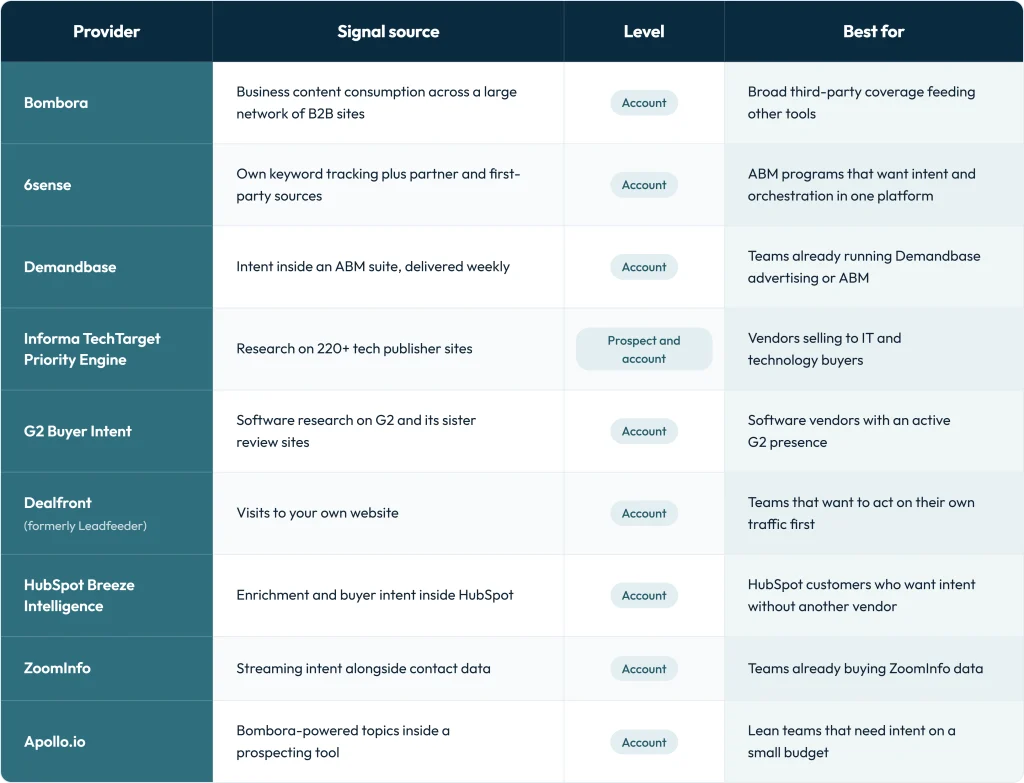
| Quick answer: The best intent data provider depends on where you want signals to come from. Bombora is the reference source for third-party research signals. 6sense and Demandbase bundle intent with ABM orchestration. Informa TechTarget Priority Engine suits companies selling to IT buyers, and G2 Buyer Intent shows active software evaluation. Leadfeeder and HubSpot cover your own website traffic, while ZoomInfo and Apollo.io add intent to contact data. Pick the signal source first, then the vendor. |
The 9 providers at a glance
What intent data is, and why providers disagree?
Intent data is a record of behavior showing that a company, or someone at it, is researching a topic, product category, or vendor. Teams use it to decide which accounts to call, advertise to, or nurture first.
The disagreement comes from the source. There are five main places a provider can watch:
- Third-party research networks: what people at a company read across many independent B2B sites.
- Publisher networks: research on sites a single media company owns, often with registered readers.
- Review sites: product, category, comparison, and pricing page views on software review platforms.
- Your own website: which companies visit, how often, and which pages they read.
- Data and prospecting platforms: intent added to a contact database, often licensed from one of the sources above.
A company can be busy on review sites and silent on publisher networks, or the reverse. When two providers disagree, they are usually both right about what they can see.
[IMAGE: intent-data-signal-sources-2026.png, the five signal sources as stacked layers with example providers]
How we compared the intent data providers
We reviewed each provider’s public product pages, help documentation, and announcements, checked on 7 October 2026. This is a documentation-based comparison, not a hands-on accuracy test. We compared:
- Where the signal comes from, and whether the provider says so clearly
- Whether intent is shown at account level, prospect level, or both
- How often data refreshes
- Which CRMs, MAPs, and ABM tools it connects to
- How it describes consent and privacy, especially for EU data
We have not included accuracy percentages or customer results, because they are vendor-reported and cannot be compared fairly across providers.
Third-party research signals
Bombora
Bombora’s Company Surge product identifies companies that are researching a topic more than usual. Bombora says it analyzes the business content consumption of millions of B2B companies and gives each account a topic score from 0 to 100. It is delivered into Salesforce, into email and audience tools, and through a long list of partners, which is why its data shows up inside other products in this guide.
- Choose it if you want broad third-party coverage that can feed your CRM, ads, and other tools.
- Skip it if: you need prospect-level names rather than account-level surges.
- Pricing: annual contract; ask for a quote.
6 senses
6sense combines its own keyword-based intent tracking with partner data and first-party signals. On its intent data page, it describes unlimited custom keywords across more than 40 languages, plus integrations with review sites and providers including Bombora and G2, and web deanonymization that matches anonymous traffic to accounts. It then predicts each account’s buying stage.
- Choose it if you run ABM and want intent, buying-stage prediction, and orchestration in one platform.
- Skip it if you only need a clean intent feed into your CRM. You will pay for platform features you do not use.
- Pricing: quote-based platform pricing.
Demandbase
Demandbase includes intent inside its ABM suite. Its documentation describes segmenting accounts by intent strength, the number of people researching, and a trending score, with new intent data delivered every Sunday for use on Monday morning.
- Choose it if you already use Demandbase for advertising or account-based programs.
- Skip it if: you want a standalone intent feed with nothing else attached.
- Pricing: quote-based.
Publisher-network signals
Informa TechTarget Priority Engine
Priority Engine draws on research activity across Informa TechTarget’s network of more than 220 technology-focused sites. Its main difference is granularity: it works at the prospect level as well as the account level, showing which technologies and vendors named people are researching. Informa TechTarget describes these prospects as permissioned and GDPR-compliant, and the product connects to 6sense, Demandbase, Outreach, and Salesloft.
- Choose it if you sell to IT buyers and want named prospects, not only account surges.
- Skip it if your buyers are outside technology, where the network has less coverage.
- Pricing: annual contract; ask for a quote.
Review-site signals
G2 Buyer Intent
G2 Buyer Intent shows which companies are researching your product, your category, or your competitors on G2. G2 says it captures activity from around 200 million software buyers a year across G2, Capterra, Software Advice, and GetApp, including product and category page views, comparisons, and pricing page visits. It connects to Salesforce, HubSpot, Marketo, 6sense, Demandbase, Outreach, LinkedIn, and ZoomInfo.
- Choose it if you sell software and buyers compare you on review sites. These are late-stage signals.
- Skip it if you are not a software company or have little review-site presence.
- Pricing: sold as part of G2 seller packages; ask for a quote.
Signals from your own website
Your own traffic is often the most accurate signal you have. A company reading your pricing page three times this week is more telling than any third-party surge.
Leadfeeder (formerly Dealfront)
Leadfeeder identifies which companies visit your website using IP-based company matching and shows the pages they read and how often they return. The company now operates under the Leadfeeder name, according to its website. By default it shows company visits, not individuals, which matters for EU privacy. It offers more than 50 behavioral and firmographic filters and connects to Salesforce, HubSpot, Pipedrive, Zoho, GA4, and Slack.
- Choose it if you want to act on website visits before buying third-party data, especially with European traffic.
- Skip it if: your website gets too little B2B traffic to produce useful signals.
- Pricing: tiered plans; check current pricing on the vendor site.
HubSpot Breeze Intelligence
Breeze Intelligence is HubSpot’s data enrichment and buyer intent product, built after HubSpot acquired Clearbit. HubSpot describes three parts: enrichment from more than 40 company and contact attributes, buyer intent that adds high-fit, high-intent companies to the CRM, and form shortening when data is already known. It runs on more than 200 million company and buyer profiles.
- Choose it if you run HubSpot and want intent inside the CRM without another vendor. Our HubSpot Marketing Hub review covers the wider platform.
- Skip it if you need deep third-party research signals or do not use HubSpot.
- Pricing: uses HubSpot credits; check your plan.
Intent inside data and prospecting platforms
ZoomInfo
ZoomInfo offers account-level streaming intent, built on its acquisition of Clickagy, alongside its contact database. In its description of the intent product, it describes alerts that fire when a company’s search activity on a topic rises, so reps can reach out while interest is alive.
- Choose it if you already buy ZoomInfo contact data and want intent in the same workflow.
- Skip it if you only need intent and not a full contact database.
- Pricing: quote-based, usually bundled.
Apollo.io
Apollo’s buying intent comes from Bombora and shows at the company level. According to Apollo’s help center, every plan includes it, with 1 topic on the free plan, 6 on Basic and Professional, and 12 on Organization. Data refreshes weekly and shows a 12-week trend. Apollo only displays scores of 61 and above, marking 75 to 100 as high intent.
- Choose it if you are a small team that wants intent and contacts in one affordable tool.
- Skip it if: you need many topics or prospect-level research signals.
- Pricing: included in Apollo plans, which are listed publicly.
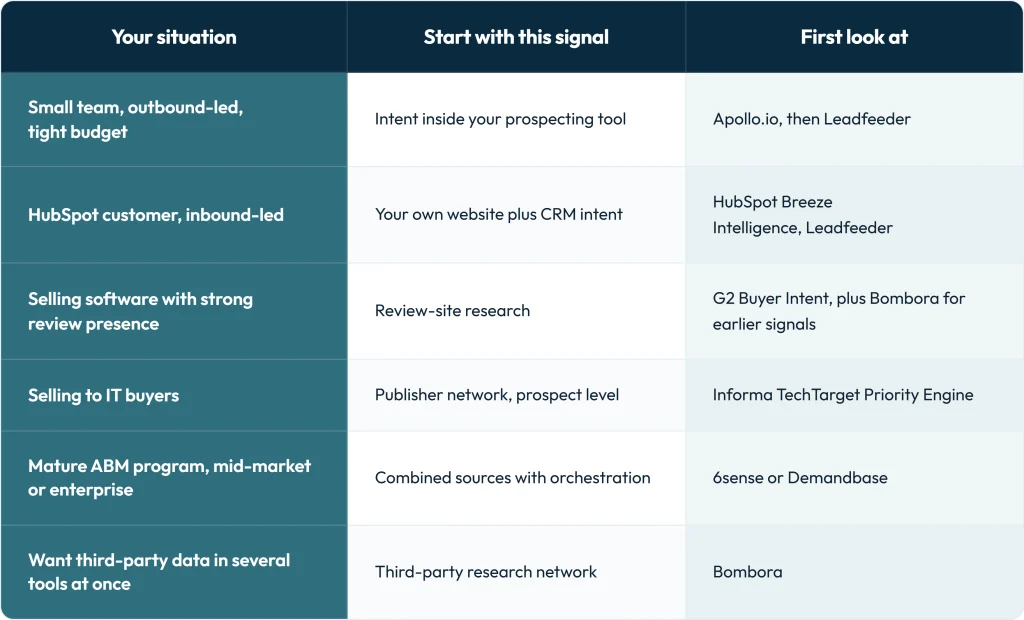
Decision table: which intent data providers fit your team
Five questions to ask in every intent data demo
- Where exactly does the signal come from, and what share is your own data versus licensed from partners?
- How many topics are in your taxonomy, and how often do you add or retire topics?
- How often does data refresh, and how long does a surge stay visible?
- Can you show the accounts you would have flagged last quarter next to our closed-won deals?
- What is your legal basis for collecting this data in the EU, and can we see it in writing?
The fourth question does most of the work, and it applies to all intent data providers, large or small. A provider confident in its data will run that backtest. One that will not is telling you something.
Common mistakes when buying intent data
Choosing topics that are too broad
“Cloud” or “marketing” will surge constantly and tell you nothing. Pick topics that match the problem your product solves and the words buyers use for it.
No plan for what sales does next
A surging account with no follow-up rule is wasted spend. Agree on who acts on each signal, how fast, and what message they send before the contract starts.
Judging accuracy too early
One month of data is noise. Give any provider at least one full sales cycle, measured against pipeline, before deciding.
When you are ready to go deeper, compare the best B2B lead generation software for the tools that turn these signals into contacts and sequences. For the strategy side, B2BNeed’s guide on combining intent data with AI personalization covers how to turn signals into relevant outreach.
FAQs:
What is the difference between first-party and third-party intent data?
First-party intent comes from your own website, product and email activity. Third-party intent is research activity captured elsewhere, such as research networks, publisher sites and review platforms.
Which intent data provider is the most accurate?
No single one of the intent data providers is the most accurate for every company, because each watches different sources. The best test is to compare a provider’s past signals with your own closed-won deals.
Is intent data GDPR compliant?
It depends on how each provider collects data and its legal basis, especially for website visitor identification in the EU. Ask each vendor for its data processing terms in writing.
Do I need an ABM platform to use intent data?
No. Many teams start with one intent feed into the CRM and a clear follow-up rule, then add an ABM platform once volume justifies it.
How often is intent data updated?
It varies by provider, from streaming alerts to weekly refreshes. Demandbase and Apollo, for example, both refresh weekly.