

The HubSpot vs. ActiveCampaign comparison frustrates most people who do it carefully because the more you look at both platforms, the less they seem to be competing. ActiveCampaign at $49/month is the best email automation platform in its price band. HubSpot at $800/month is a full CRM and revenue platform that also includes email automation. Comparing them on ’email marketing’ is like comparing a socket wrench to a full toolbox on the grounds that both contain a socket wrench.
That framing matters practically. If you are evaluating these two platforms head-to-head, you are probably asking the wrong question. The right question is, “What does your marketing function actually need to connect to?”
The Comparison Is Usually Misframed
Most HubSpot vs. ActiveCampaign articles treat the 16x price difference as the central fact and then try to justify HubSpot. That is backwards. The 16x difference is a signal that these tools are sized for different jobs, not that one is overpriced.
ActiveCampaign is sized for the marketing function when marketing operates as a standalone function. You have a list, you send campaigns, you run automated sequences, and you track opens and clicks. That is a complete job, and ActiveCampaign does it better per dollar than any platform at its price point.
HubSpot is sized for the marketing function when marketing is part of a connected revenue operation. Your marketing contacts need to become a sales pipeline. Your closed deals need to inform which campaigns get sent to which segments. Your service tickets need to be visible to the account manager before a renewal call. When those connections exist or need to exist, you are not shopping for a marketing tool. You are shopping for a platform.
Once you have decided which category you need, the comparison becomes considerably simpler. What You Get at Each Price Point
What You Get at Each Price Point
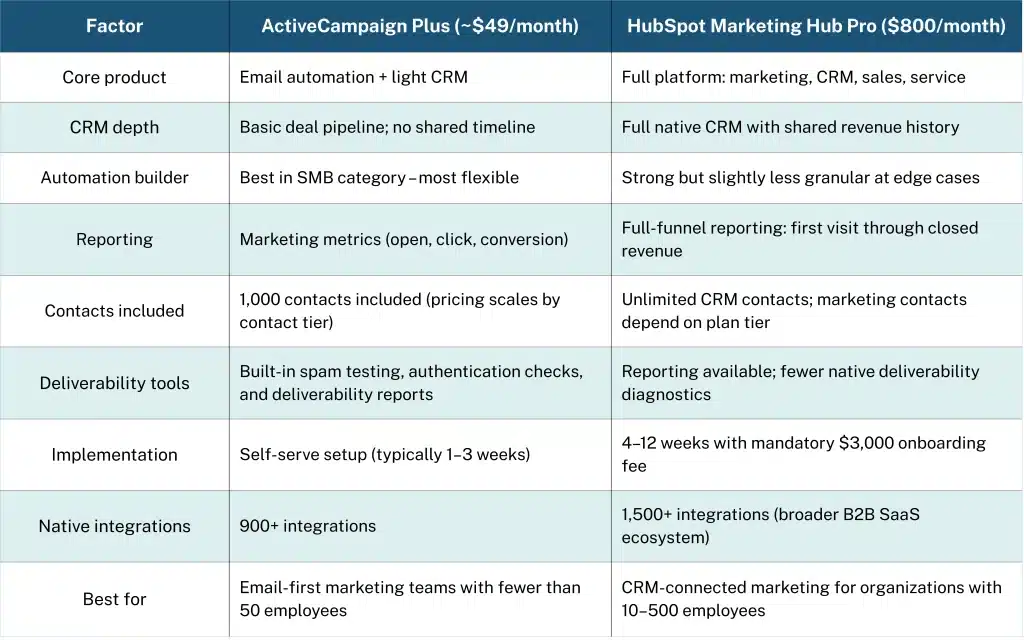
ActiveCampaign Plus: $49/month for 1,000 contacts, scaling to $149/month for 10,000, and $229/month for 25,000. HubSpot Pro: $800/month flat (3 seats included), $3,000 mandatory onboarding. Prices verified April 2026.
When ActiveCampaign Is the Right Answer
Your marketing team operates standalone
If sales run its own outreach, service is in a separate system, and marketing’s job is to drive inbound leads that are handed off manually, ActiveCampaign’s architecture is not a limitation. It is exactly right. You are running a targeted, well-automated email marketing operation. The $49/month Plus tier delivers more email automation depth than most teams at this stage can meaningfully use.
You have a large contact list and a small team
ActiveCampaign’s per-contact pricing model is meaningfully more economical when the list is large relative to team size. A 3-person marketing team with 60,000 contacts pays roughly $229/month. HubSpot’s contact tier add-ons for the same list size at Pro would add $1,000+ per month to the base $800. If the list is the primary asset and working it efficiently is the primary job, ActiveCampaign’s model saves $10,000 to $15,000 per year.
Email deliverability is a primary concern
ActiveCampaign’s built-in deliverability tools spam scoring, domain authentication checks, engagement-based sending, and deliverability diagnostics are more granular than HubSpot’s at an equivalent tier. For teams managing high-volume email programs where inbox placement rate is a critical metric, this tooling is a practical advantage.
When HubSpot Is the Right Answer
Sales needs to see what marketing is doing
The moment your sales team needs to see which marketing emails a prospect opened before a call or needs to know that a contact just re-engaged with three blog posts this week, you need a shared data layer. ActiveCampaign does not provide this natively. Integrating it with a CRM adds cost, adds maintenance, and never achieves the completeness of a genuinely shared contact record. Every integration is also a potential failure point when either platform updates.
You need marketing ROI visibility to closed revenue
HubSpot traces a contact from first page visit through campaign attribution, lead stage, deal creation, and closed revenue. That reporting is what CFOs and growth teams need to justify marketing spend. ActiveCampaign’s reporting loop closes at marketing metrics. If your board asks which campaign generated which pipeline this quarter, HubSpot is the only realistic answer in this comparison.
You plan to add Sales Hub or Service Hub within 12 months
HubSpot’s most underappreciated advantage is the cost of adding the second product. Marketing Hub plus Sales Hub on the same CRM data is a native integration that works immediately. Marketing Hub plus a separately purchased CRM is a managed integration that requires maintenance, breaks during platform updates, and never has complete data parity. If you are going to be on HubSpot’s full platform, starting with Marketing Hub avoids a migration project 12 months from now.
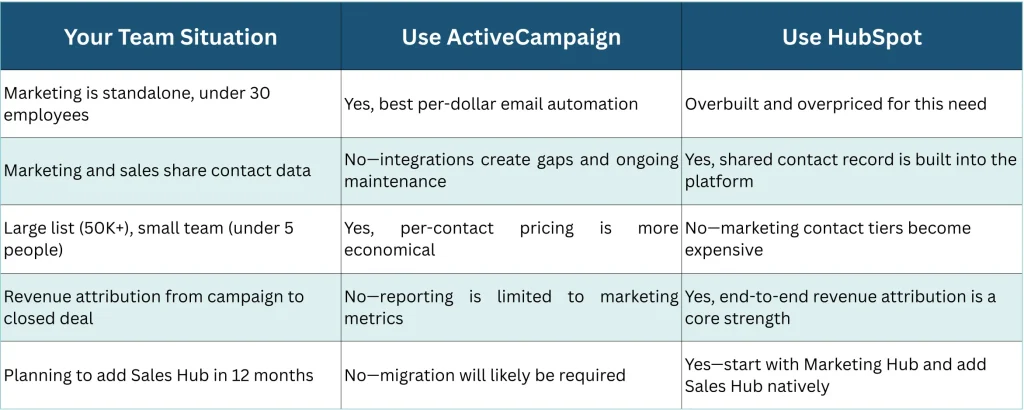
Five Scenarios: Which Platform Wins
The Migration Cost Nobody Mentions
One factor rarely appearing in HubSpot vs. ActiveCampaign comparisons: migration cost. A company that starts on ActiveCampaign at 10 employees and decides they need HubSpot at 50 employees faces a real project. Contact history, automation sequences, segmentation logic, and campaign attribution all need to move. That migration typically costs $3,000 to $8,000 in implementation fees and 6 to 10 weeks of internal team time.
This does not mean you should choose HubSpot pre-emptively. It means the decision should account for how likely you are to need the platform upgrade within 24 months. A company confident it will stay email-led for the next two years should use ActiveCampaign without hesitation. A company expecting to hire a sales team in the next year should start on HubSpot now and avoid the migration project entirely.
The Verdict
The HubSpot vs. ActiveCampaign comparison resolves on one structural question: does your marketing function need to share data with sales and service, or does it operate independently? If done independently, ActiveCampaign is the better answer at a fraction of the cost. If it connects to sales pipeline, deal tracking, and customer service activity, HubSpot is the answer, and the cost differential is justified by the platform value, not the email marketing feature alone.
Most B2B companies have a clear answer to that question. The ones that do not should resolve it before selecting a platform. The platform choice is the easy part. Understanding what your marketing function actually needs to connect to is the real work. For the full marketing automation landscape, see our guide to the best B2B lead generation software in 2026.
FAQs:
HubSpot vs. ActiveCampaign: which is better for B2B email marketing?
ActiveCampaign wins on value for standalone email: better automation, stronger deliverability tools, cheaper at scale. Need email linked to sales pipeline and CRM data? HubSpot is the only real option.
Can ActiveCampaign replace HubSpot?
Yes, for email and automation. No for CRM, sales pipeline, service ticketing, or full-funnel reporting. Most teams end up adding a separate CRM like Pipedrive, which cuts into the savings.
At what point does a B2B company outgrow ActiveCampaign?
When sales needs visibility into marketing activity on shared contacts, not at a fixed headcount or revenue point. Usually happens between the first sales hire and 50 employees. Spotting it early makes the switch smoother.
Is HubSpot’s mandatory onboarding fee negotiable?
No. $3,000 (Professional) or $7,000 (Enterprise), even for experienced teams. Budget for it upfront.
What is the most common mistake in this platform decision?
Choosing HubSpot for its “enterprise” branding without using the integrations that justify the cost. Using it only for email means paying up to 16x more for unused features. If that’s you, ActiveCampaign is likely the better fit.