

HubSpot Q4 2025 revenue hit $846.7 million, up roughly 20% year over year. 248,000 customers across 135 countries. HubSpot serves more B2B marketing software customers than any competitor in the mid-market segment.
But biggest is not the same as best for you. HubSpot Marketing Hub review 2026 answers the only question worth asking in 2026: should you actually pay $800 to $3,600 per month for it, or has the new credit-based pricing model made the value math harder?
This review covers the full picture. The short answer: HubSpot remains the strongest all-in-one for growth-stage B2B teams. But the HubSpot Breeze AI rollout has reshuffled the cost model, mandatory onboarding fees hit harder than buyers expect, and the shared credit pool creates internal competition. This review cuts through the marketing hype to the genuine strengths.
HubSpot Marketing Hub Review 2026: Quick Verdict
HubSpot Marketing Hub review 2026
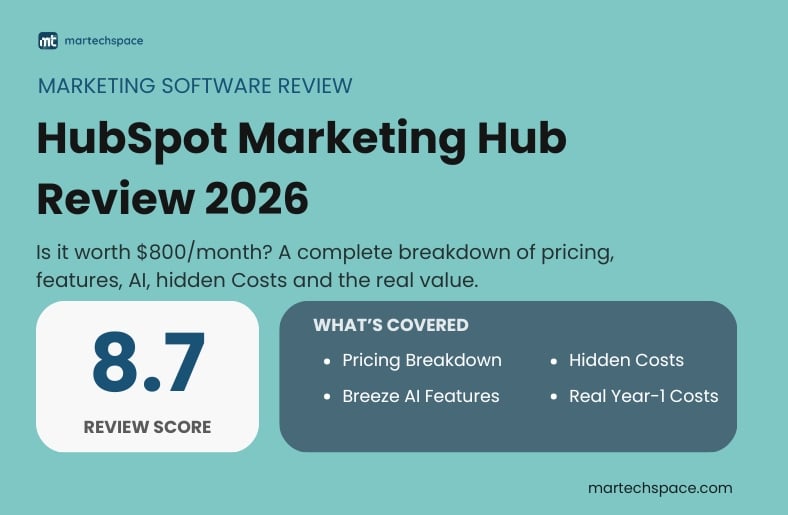
Score: 8.7 / 10 | Best for growth-stage B2B SaaS, agencies, and services companies between 10 and 500 employees.
Real Year-1 cost: $9,600 to $43,200 subscription + $3,000 to $7,000 mandatory onboarding + credit overages. Typically 2 to 3.3x the headline subscription price.
Skip if: Under 10 employees, need enterprise-grade reporting at scale, or want predictable AI pricing.
What Is HubSpot Marketing Hub?
Marketing Hub is HubSpot’s marketing automation platform, sitting inside a wider ecosystem (Sales Hub, Service Hub, Operations Hub, Content Hub) on a single CRM for B2B SaaS. The pitch: instead of connecting Salesforce, Marketo, and Zendesk separately, run everything on HubSpot. One CRM for B2B SaaS, one reporting layer, one source of truth.
In 2026, the platform is built around three layers. The Marketing Hub core covers lead nurturing tools, a landing page builder, email marketing automation, CRM automation, lead scoring, and A/B testing. HubSpot AI is the unified AI suite (fully launched in 2026) spanning Assistant, Agents, and Intelligence. The HubSpot CRM powers everything underneath
The Q4 2025 highlight: HubSpot acquired Dashworks in April 2025 to strengthen Breeze Copilot. By 2026, Breeze has matured into 20+ Agents and Assistants.
HubSpot Marketing Hub Pricing 2026: Full Breakdown
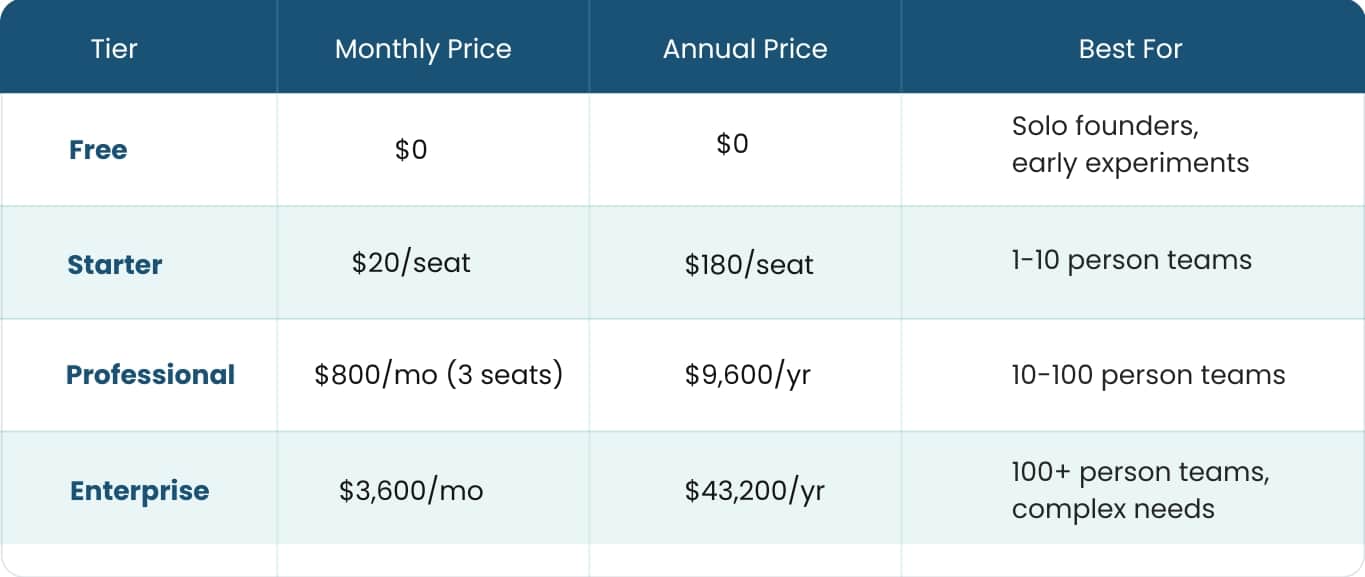
HubSpot publishes its pricing, a real differentiator in this category. But the published numbers are only part of the story. Here’s what we found on HubSpot pricing 2026 at each tier.
Subscription Tiers
Mandatory Onboarding Fees
These fees apply regardless of prior HubSpot experience and cannot be negotiated away:
- Professional: $3,000 one-time (mandatory at signup)
- Enterprise: $7,000 one-time (mandatory at signup)
HubSpot Breeze AI Costs: The 2026 Shift
HubSpot Breeze AI is locked behind Professional and Enterprise tiers. As of April 14, 2026:
- Breeze Customer Agent: $0.50 per resolved conversation (down from $1.00)
- Breeze Prospecting Agent: $1.00 per qualified lead
- HubSpot Credits: $10 per 1,000 monthly / $9 per 1,000 annual
- Professional: 3,000 credits/month included
- Enterprise: 5,000 credits/month included
- Unused credits: Expire monthly — do not roll over
The April 2026 outcome-based model on the two flagship HubSpot Breeze AI agents is buyer-friendly. You pay when the AI delivers, not when it attempts.
The Real Year-1 Number
HubSpot Marketing Hub review 2026 breaks down the real Year-1 number for a 50-employee B2B SaaS company on Marketing Hub Professional:
- Subscription: $9,600
- Mandatory onboarding: $3,000
- Contact tier upgrades: $2,400
- Breeze credit overages: $1,800
- Internal admin time (0.25 FTE, 90 days): ~$15,000
Real Year-1 cost: ~$31,800 — 3.3x the headline subscription price.
Refer to A0007_inline_costs.svg: gap between $9,600 quoted and $31,800 real Year-1 cost.
Hidden Cost Traps
HubSpot Marketing Hub review 2026 found five hidden cost traps that catch most buyers off guard:
- Auto-upgrade trap: HubSpot auto-purchases higher tiers when you hit limits. Disable on day one.
- Contact tier creep: Marketing contact limits auto-trigger price jumps. Audit quarterly.
- Per-seat additions: $45/month per extra Professional seat, $75/month per extra Enterprise seat.
- No credit rollover: Unused credits expire monthly.
- Shared credit pool: Sales and support team usage reduces marketing credit budget without warning.
What Genuinely Good About HubSpot Marketing Hub in 2026
1. The All-in-One Advantage
One platform, one data layer, one bill. Marketing Hub plus Sales Hub plus Service Hub on shared data eliminates integration overhead. For growth-stage teams these compounds: adding Sales Hub or Service Hub later is native, not a forced integration project.
2. HubSpot Breeze AI in Practice
HubSpot Breeze AI is real, mature, and useful. The 20+ agents handle customer journey automation (resolves 65% of conversations, cuts resolution time 39%), AI-powered marketing automation, and ABM landing page building, and firmographic and technographic data enrichment.
The outcome-based model on Customer Agent ($0.50/resolved conversation) and Prospecting Agent ($1.00/qualified lead) meaningfully shifts financial risk to the vendor. With HubSpot AI, you pay for actual results, not AI activity.
3. Inbound Lead Capture and Nurture
Forms, a landing page builder, email marketing automation, CRM automation. This is HubSpot’s home turf and nobody in the mid-market does it better. The landing page builder is mature, marketing automation is genuine, and the analytics are usable by marketers without analyst support.
4. Native Integration Depth
Most modern B2B tools have native HubSpot connectors: Salesforce, Slack, Zoom, Outreach, Salesloft, Drift, Intercom, Stripe, Shopify. The integration marketplace is among the largest in B2B SaaS.
5. A Free Tier That Holds Up
HubSpot’s free CRM tier carries a 1 to 5-person team for months before HubSpot Professional pricing makes financial sense. Most competitors offer free tiers that force upgrade within weeks. HubSpot’s does not.
HubSpot Marketing Hub Review 2026
- The Starter-to-Professional jump is steep. Moving from $20/seat to $800/month for 3 seats is roughly a 13x cost increase with no middle tier. Teams often stall for months trying to justify the jump.
- Enterprise reporting depth. Salesforce plus Marketo delivers deeper marketing analytics. HubSpot’s marketing analytics feel shallow at enterprise scale.
- Mandatory onboarding fees. $3,000 and $7,000 fees that are non-negotiable even for experienced HubSpot teams. This is the most buyer-unfriendly element of an otherwise transparent pricing model.
- Credit pool politics. Shared credits mean marketing, sales, and service compete for the same monthly budget. Without active governance, one heavy-use team depletes credits for everyone.
- Limited external knowledge base connections. Breeze has limited integration with knowledge tools like Notion, Google Drive, and Confluence. Teams with documentation in these tools need third-party AI bridges.
HubSpot Marketing Hub vs. Alternatives in 2026
The HubSpot vs Marketo comparison drives most mid-to-enterprise evaluations. Here is how Where HubSpot Marketing Hub Falls Short in 2026stacks them up:
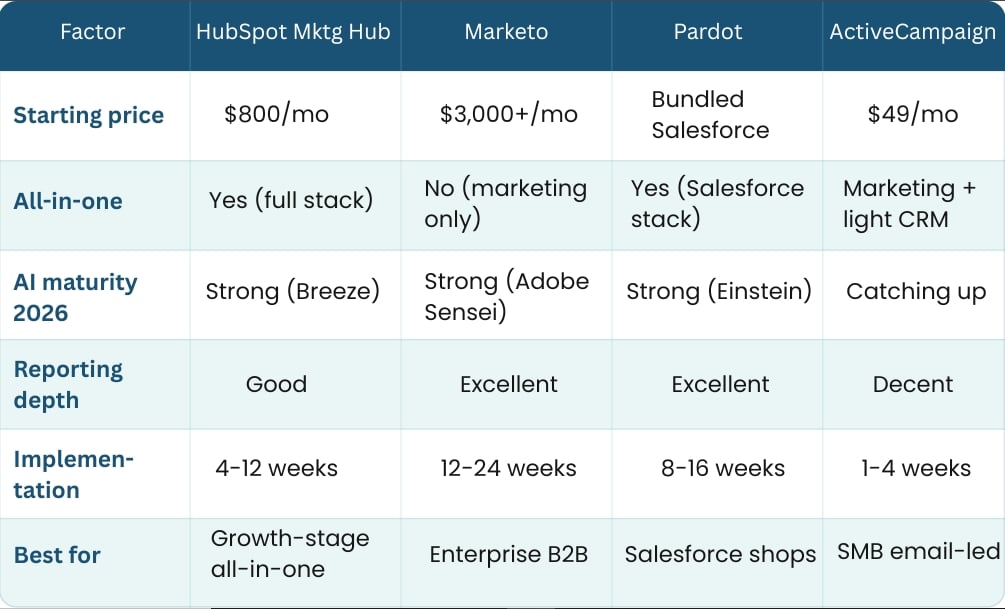
On HubSpot vs Marketo: for growth-stage B2B under 500 employees, HubSpot wins on usability, all-in-one breadth, and time-to-value. For enterprise B2B teams with complex multi-touch attribution needs, Marketo delivers deeper reporting. Pardot is only the right answer for teams already committed to the Salesforce ecosystem.
Who Should Buy HubSpot Marketing Hub in 2026
Buy if: you’re 10 to 500 employees and want the best CRM for marketing on one platform. Your team is growth-stage and will add Sales Hub or Service Hub within 12 months. Inbound marketing software is a core motion. You need a usable UI that drives high rep adoption.
Skip if: Under 10 employees (Starter or free is right, Pro is overkill). 500+ employees with complex enterprise reporting needs. Already deep in the Salesforce stack. Need predictable AI marketing automation without consumption-based surprises. Primary motion is outbound sales
Final Verdict: HubSpot Marketing Hub Review 2026
HubSpot Marketing Hub review 2026 conclusion: the platform remains the strongest all-in-one for growth-stage B2B. The HubSpot marketing CRM data layer, the Breeze AI rollout, and the April 2026 shift to outcome-based AI marketing automation add up to a platform that is mature, useful, and fairly priced for the value it delivers to the right buyer.
For teams under 10 employees: the free tier or Starter. Professional is overkill.
For 500+ employee enterprises with complex reporting: Marketo vs HubSpot delivers deeper enterprise capability.
For mid-market growth-stage B2B SaaS, agencies, and services companies between 10 and 500 employees: HubSpot Marketing Hub review the verdict is clear. It is the right platform. Just budget realistically: real Year-1 cost runs 2 to 3.3x the headline subscription, and the credit pool requires active governance.
Score: 8.7 / 10 | Buy if you’re growth-stage and want everything in one platform. Skip if you’re enterprise-scale or pre-product-market-fit.
FAQs:
HubSpot Marketing Hub review 2026: is it worth $800/month?
For growth-stage B2B between 10 and 500 employees, yes. But budget correctly. Our analysis found that Professional real Year-1 cost runs $25,000 to $50,000 when onboarding, contact overages, and credit usage are fully counted.
What is HubSpot Breeze AI and how much does it cost?
HubSpot Breeze AI spans Assistant (chat), Agents (task automation), and Intelligence (enrichment). Customer Agent: $0.50/resolved conversation as of April 14, 2026. Prospecting Agent: $1.00/qualified lead. Other features run on Credits ($10 per 1,000 monthly). Professional and Enterprise include monthly credit allocations.
HubSpot vs Marketo: which wins in 2026?
For mid-market B2B under 500 employees, HubSpot wins on usability on usability and total cost of ownership. Marketo vs HubSpot wins for enterprise B2B with complex attribution. The crossover: roughly 500 employees with dedicated B2B Marketing Software headcount.
Can I negotiate or avoid the HubSpot onboarding fees?
No. Onboarding fees are mandatory at Professional ($3,000) and Enterprise ($7,000). They are non-negotiable. Budget these from the start of procurement, not after the contract is signed.
What is HubSpot Enterprise cost for a 100-person team?
HubSpot Enterprise cost starts at $3,600/month ($43,200/year). Add $7,000 mandatory onboarding, $10,000 to $20,000 in contact tier fees, and $5,000 to $15,000 in Breeze credit usage. HubSpot pricing 2026 at Enterprise tier runs $65,000 to $90,000 all-in for a typical 100-person team in Year 1.
Is HubSpot Marketing Hub worth it compared to ActiveCampaign?
ActiveCampaign starts at $49/month for email-led marketing automation with light marketing CRM. HubSpot Professional starts at $800/month for a full marketing-sales-service platform on shared CRM data. The difference is scope, not quality. ActiveCampaign wins on price for email-only motions. HubSpot wins when marketing, sales, and service need to share one CRM
Will HubSpot prices increase in 2026?
Expect 5 to 10% annual increases at renewal plus contact tier upgrades as the database grows. Negotiate multi-year contracts with capped renewal rates to control the budget impact in Year 2 and Year 3.
Is HubSpot the best marketing automation platform in 2026?
For mid-market B2B, yes. This marketing automation review found HubSpot outperforms ActiveCampaign on breadth and Marketo on cost-to-value for teams under 500 employees. HubSpot Enterprise cost is higher than ActiveCampaign but significantly lower than Marketo for comparable feature depth at mid-market scale.