

For most of the last decade, email open rates were the first number on every B2B email report. They were easy to collect, easy to compare, and easy to explain to a board. In 2026 they are also the least reliable number on the page.
Two changes did the damage. Apple Mail Privacy Protection now affects roughly 55% to 60% of all email opens, according to Litmus, which means many recorded opens never involved a person. And in 2026, France’s CNIL and Italy’s Garante confirmed that tracking an individual’s opens in a marketing email needs consent. Contacts who have not opted in should receive emails with no tracking pixel at all.
| Quick answer: Email open rates are no longer a reliable measure of B2B email performance. Apple Mail Privacy Protection loads images automatically and inflates opens, and the CNIL and Garante rules require consent before tracking individual opens in marketing emails. B2B teams should report deliverability (delivered and bounce rates), click-to-delivered rate, reply rate, and pipeline influenced by email, and show open rates only for contacts who consented, clearly labeled. |
Why did email open rates stop meaning what they used to?
An open is recorded when an email client loads a tiny tracking image. For years, that was a fair proxy for “a person looked at this email.” Three things have broken the link between the image loading and a human reading.
1. Apple Mail Privacy Protection loads images for the reader.
Apple introduced Mail Privacy Protection in 2021. When it is on, Apple downloads remote content, including tracking pixels, through its own servers, often before the recipient reads the email and sometimes when they never do. The sender sees an open either way. Litmus’s September 2026 data, drawn from more than 1.5 billion opens, puts Apple’s share of opens at 76.56%, a figure that includes these privacy-affected opens, and Litmus states that such opens are not considered reliable.
In practice, any list with a large share of iPhone and Apple Mail users shows open rates far higher than real reading behavior, and the number rises or falls with your audience’s device mix rather than with your content.
2. Consent rules remove tracking for part of your list.
The CNIL’s recommendation, published on 14 April 2026, and the Garante’s guidelines, adopted on 17 April 2026, both treat individual open tracking in marketing email as requiring consent. That applies to B2B senders too. Our email tracking pixel consent audit covers the rules in detail.
The reporting effect is simple. Once you send pixel-free emails to contacts who have not consented, those contacts never register an open. Your open rate is now calculated on a shrinking, self-selected group: people who agreed to be tracked. That group is likely to be more engaged than average, so the number can look better while your real reach is unchanged.
3. Security tools open and click on the reader’s behalf.
Many corporate email security systems scan incoming messages and follow links to check them before delivery. That can create opens and clicks seconds after sending, from no human at all. B2B lists are especially exposed because most recipients sit behind company email gateways.
What each change does to your numbers
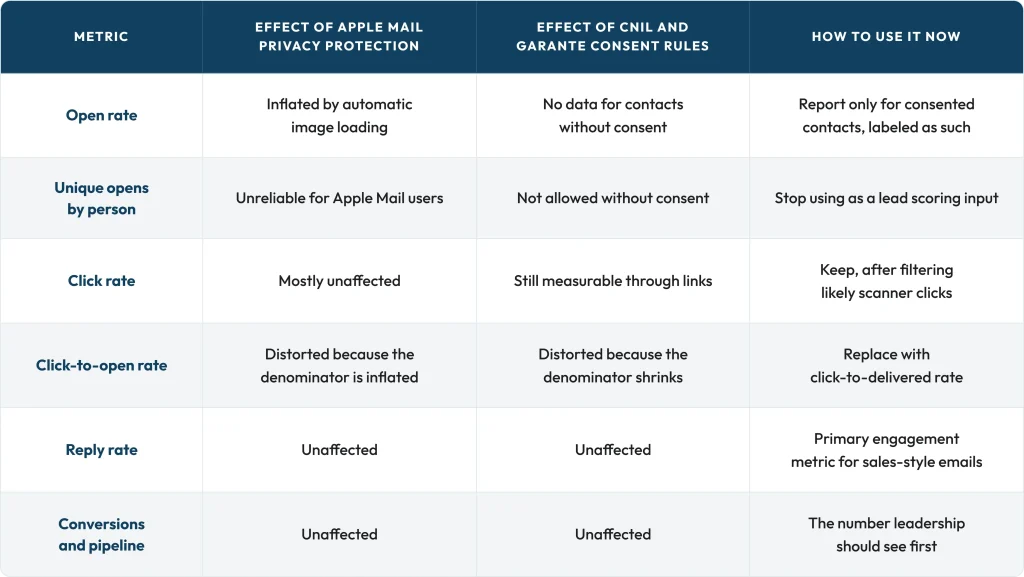
The pattern is clear: anything that depends on the open pixel is now either unreliable or partly unavailable. Anything that depends on a link, a reply, or a CRM record still works.
The email metrics B2B teams should report instead
Deliverability first
If emails do not reach the inbox, nothing else matters. Report the delivered rate, hard and soft bounce rates, and the spam complaint rate for every campaign. Add inbox placement checks with seed addresses across Gmail, Outlook, and Apple Mail once a month, and watch sender reputation in Google Postmaster Tools and Microsoft’s sender tools.
Click-to-delivered rate
Divide unique human clicks by delivered emails. Unlike click-to-open rate, this does not depend on the open pixel, so it stays comparable across consent groups and device mixes. Filter clicks that arrive within seconds of delivery or hit every link in an email at once, which are common signs of automated scanning.
Reply rate and conversations
For sales-led and account-based emails, replies are the clearest sign of a human reading. Track positive replies separately from out-of-office messages and unsubscribes by reply.
Conversions and pipeline influenced
Connect email to outcomes in your CRM: form fills, meetings booked, opportunities created, and pipeline value where an email touch came before the outcome. This is the number that justifies the email budget, and it is untouched by privacy changes.
How to restate your email benchmarks
Most teams carry open rate targets that were set before these changes. Comparing this quarter with those targets will mislead. A cleaner approach takes four steps:
- Split every report by consent status: contacts who consented to tracking and contacts who receive pixel-free emails.
- Recalculate the last four quarters on click-to-delivered rate so you have a trend line that does not depend on opens.
- Set new targets on click-to-delivered, reply, and conversion rates by segment and email type.
- Keep open rate only as a diagnostic for consented contacts, for example, to compare subject lines inside one campaign.
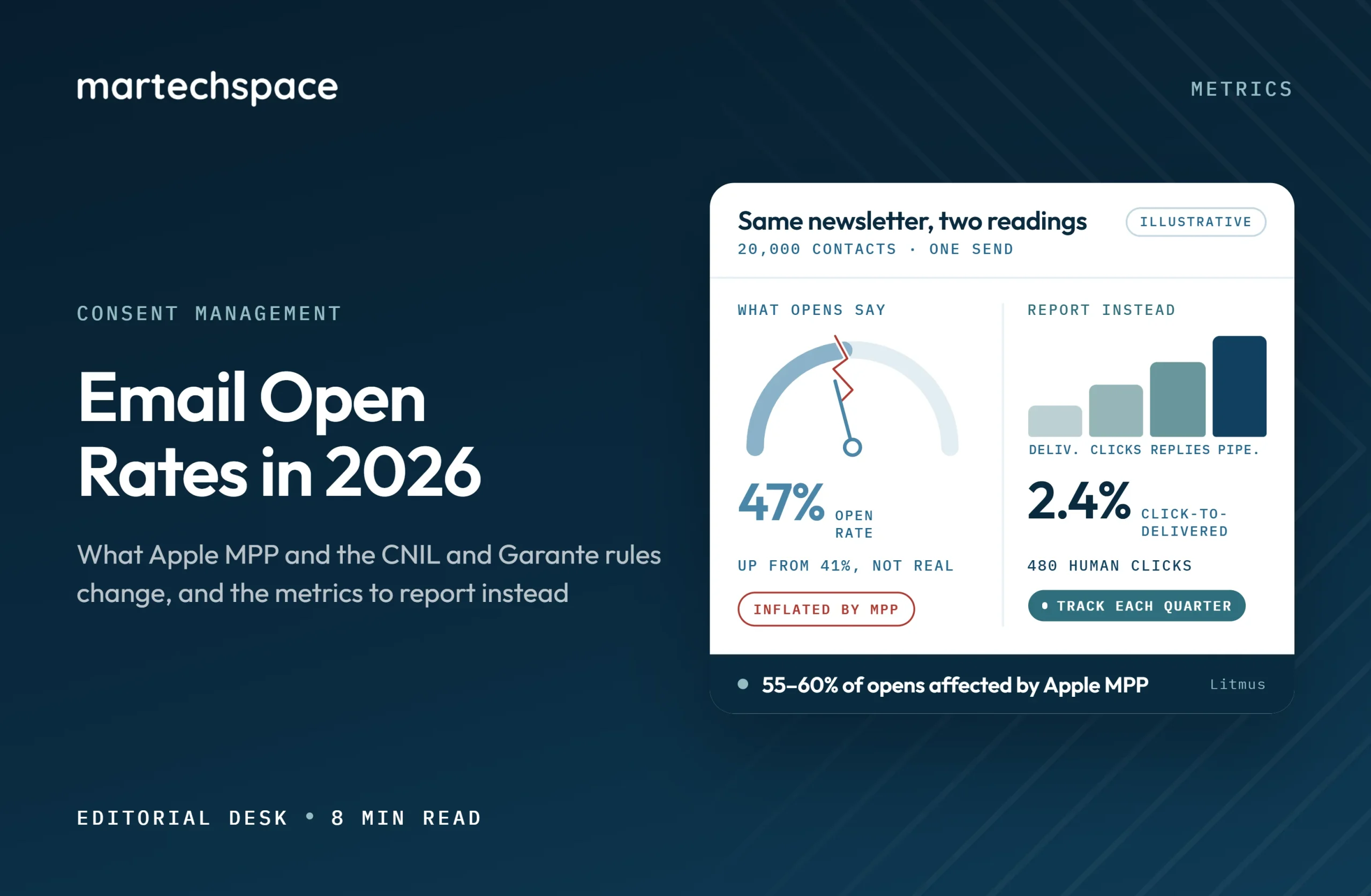
Here is an illustration. A team sends a newsletter to 20,000 contacts. Last year, it reported a 41% open rate. This year, 12,000 contacts receive the tracked version, and 8,000 receive a pixel-free version. The tracked group shows a 47% open rate, which looks like an improvement but reflects a more engaged group and Apple’s automatic loading. Across all 20,000 delivered emails, 480 unique human clicks give a 2.4% click-to-delivered rate. That is the number to compare with next quarter.
What changes in lead scoring and sales alerts?
Email open rates still feed many lead scoring models: Plenty of marketing automation setups add points for every open, and many sales engagement tools alert reps the moment a prospect opens an email. Both practices now cause problems.
- Remove open-based points from lead scoring models. They reward Apple Mail users and automated loading rather than interest.
- Turn off rep-open alerts for contacts in France and Italy unless consent is recorded, and consider turning them off everywhere: they create false urgency.
- Shift scoring weight to clicks on high-intent pages, replies, form fills, and website visits by known contacts.
- Review scoring after one quarter and compare scored leads with actual opportunities.
Our guide to intent data providers covers the account-level signals that can replace email opens in scoring.
What marketing platforms let you do
Most major email and marketing automation platforms let you turn off open tracking per email, per list, or per contact and report clicks and conversions without it. When you review your platform, check that it can:
- Store a consent field for tracking and send pixel-free versions automatically to contacts without consent
- Flag or filter likely automated clicks, and Apple privacy opens in reports
- Report click-to-delivered rate and pipeline influenced out of the box
- Keep a log of each contact’s tracking choice with a date
If you are comparing platforms, our HubSpot Marketing Hub review and HubSpot vs ActiveCampaign comparison cover two common options.
A one-page email report for 2027
Replace the old open-rate headline with a report that leadership can trust. A simple layout:
- Pipeline and conversions influenced by email this month
- Click-to-delivered rate by email type, with the four-quarter trend
- Reply rate for sales and account-based sends
- Deliverability: delivered rate, bounces, and complaints
- Consent coverage: share of contacts who agreed to tracking
- Open rate for consented contacts only, in small print
That last line is not a formality. It tells readers why the open rate is no longer the headline, and it protects you when someone compares this year’s report with an old one.
FAQs:
Are email open rates still accurate?
Not as a measure of reading. Apple Mail Privacy Protection loads tracking images automatically for many recipients, and consent rules remove open data for contacts who have not opted in.
How does Apple Mail Privacy Protection affect open rates?
It downloads email images, including tracking pixels, through Apple’s servers, which records an open whether or not the person reads the email. Litmus estimates it affects roughly 55% to 60% of opens.
Do the CNIL and Garante rules ban open tracking?
No. They require consent before tracking individual opens in marketing emails, with narrow exemptions. Contacts without consent should receive emails without a tracking pixel.
What should replace open rate as the main email KPI?
Click-to-delivered rate for engagement, reply rate for sales-style emails, and conversions and pipeline influence for business impact.
What is the click-to-delivered rate?
Unique human clicks divided by delivered emails. It does not rely on the open pixel, so it stays comparable across devices and consent groups.
Should we still use opens in lead scoring?
No. Open-based points now reward automated image loading. Score clicks, replies, form fills, and website visits instead.