

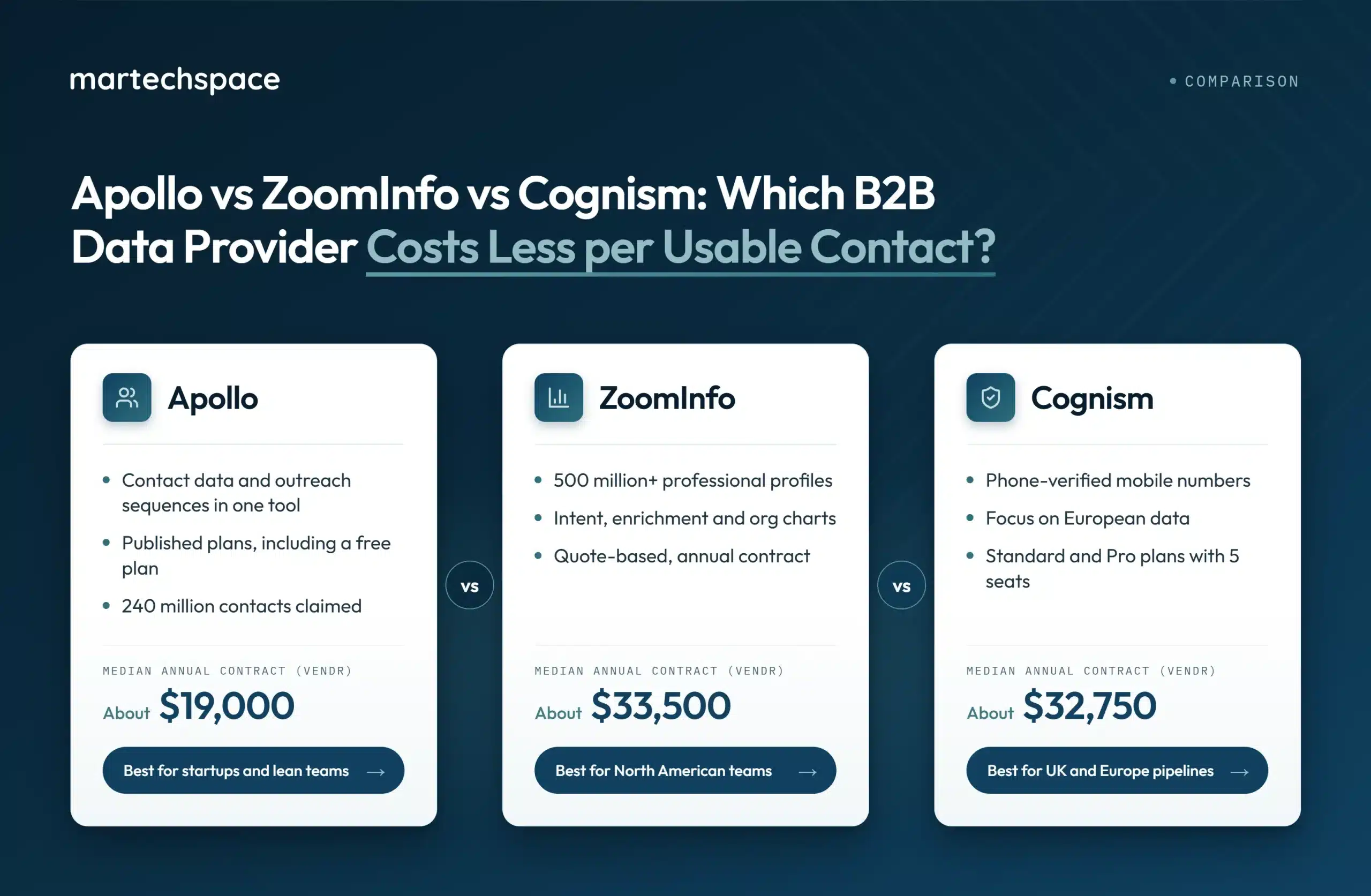
Every B2B data vendor leads with the size of its database. ZoomInfo cites more than 500 million professional profiles. Apollo cites 240 million contacts. Cognism focuses on phone-verified mobile numbers. None of those figures tells you how many of the people your team actually targets are current, reachable, and in the right market.
That is the number that decides the Apollo vs. ZoomInfo question and the Cognism question alongside it. This comparison sets out what each provider costs on real contracts, how each one prices, and where each tends to fit. Then it gives you a short test to measure the one figure that matters: cost per usable contact.
| Quick verdict: Choose Apollo if you are a lean team that wants contact data and outreach sequences in one tool at the lowest entry cost. Choose ZoomInfo if you need the broadest data, intent, and enrichment platform for a large North American team and can commit to an annual contract. Choose Cognism if much of your pipeline is in the UK and Europe and your reps rely on calling mobile numbers. Then run the same 100-contact test on all three before you sign. |
Apollo vs ZoomInfo vs Cognism at a glance
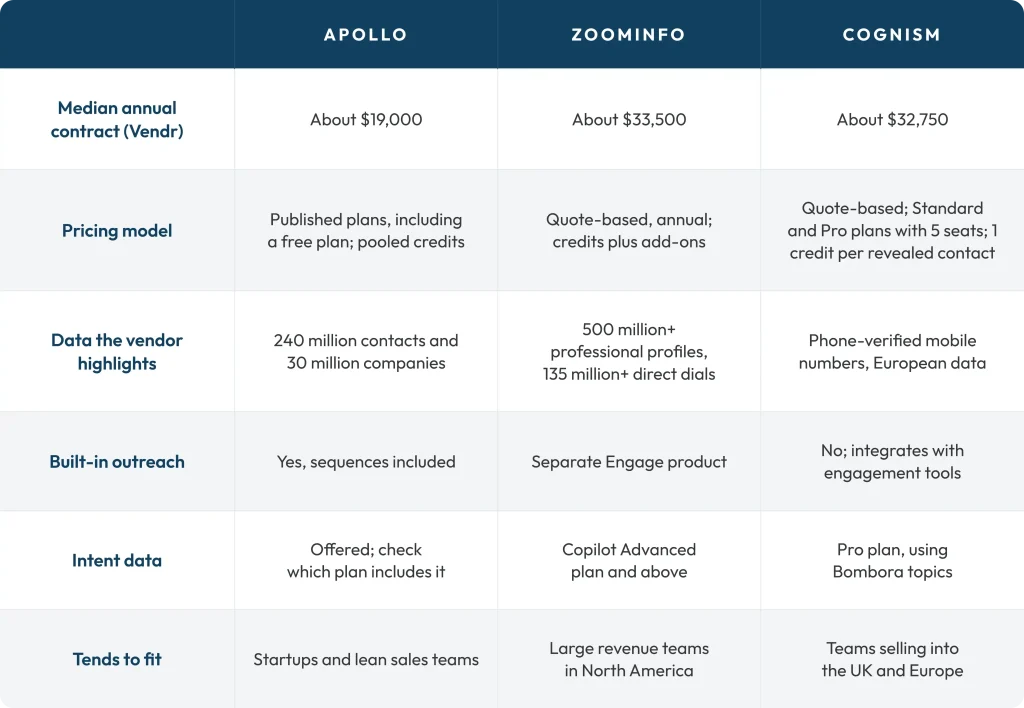
Contract figures come from Vendr purchase data for Apollo, ZoomInfo, and Cognism, checked on 23 October 2026. Database figures are each vendor’s own claims from the Apollo, ZoomInfo, and Cognism websites.
The metric that settles Apollo vs ZoomInfo: cost per usable contact
A usable contact is one you can act on today: the person still works there, the title is right, and the email delivers or the phone connects. Database size, credits, and list price all feed into it, but only this number tells you what your team really pays to reach a buyer.
| Formula: Cost per usable contact = annual contract cost ÷ (contacts your team will pull in a year × the share that proved usable in your test). |
Here is how the formula changes a decision. Suppose your team pulls 12,000 contacts a year. Provider A costs $19,000, and 60% of a test sample proves usable, so you pay about $2.64 per usable contact. Provider B costs $33,500, and 85% proves usable, so you pay about $3.28. Provider A looks cheaper. But if your reps make calls and Provider B’s usable mobiles connect far more often, the time saved can outweigh the 64-cent difference. These figures are illustrations. Your own test results are the only ones that count.
Where each provider tends to fit by region
North America
This is where all three compete hardest and where the Apollo vs. ZoomInfo choice is most often made. ZoomInfo built its business on North American data and offers the widest set of extras around it: intent, website visitor data, org charts, and technographics. Apollo is a strong value for teams prospecting into US startups and mid-market companies, especially when they want sequences in the same tool.
UK and Europe
Cognism positions itself around European data and phone-verified mobile numbers, and its Pro plan adds on-demand mobile verification. ZoomInfo lists international data as an add-on, so check the price of that line before comparing quotes. In Europe, also check how each vendor handles GDPR: what its lawful basis is for holding the data and how people can opt out.
Asia Pacific and other regions
Coverage outside North America and Europe varies by country and industry for every provider. Do not rely on any vendor’s global total. Ask for sample records from the exact countries you sell into, and test them.
How each one prices, in practice
ZoomInfo is quote-based and billed annually. Exporting a contact uses one credit, deeper data uses more, and add-ons such as Streaming Intent, Engage, and international data are priced separately. Our ZoomInfo pricing guide breaks down the six plans and the free ZoomInfo Lite option.
On list price alone, Apollo vs ZoomInfo looks like an easy call. Apollo publishes its plans, including a free plan, and pools credits across the team at the start of each billing cycle. Unused credits expire. The low entry point is why many teams start with Apollo and why some later outgrow it when they need deeper enrichment or stricter data controls.
Cognism does not publish prices. Its Standard and Pro plans each include five seats, one credit reveals one contact, and contacts you have already revealed can be viewed again for free. Vendr reports buyers save about 26% on average through negotiation, compared with about 22% for ZoomInfo and about 30% for Apollo, so there is room to move on all three.
Compliance questions to ask all three
- Where does your data come from, and what is your lawful basis for holding European contacts?
- How do people opt out, and how fast is an opt-out applied across customers?
- Do you screen phone numbers against do-not-call lists in the countries we call?
- What happens to contacts we exported if we cancel?
- Can you sign a data processing agreement with our standard terms?
If you email contacts in France or Italy, tracking rules apply to your sends as well. Our guide to email tracking pixel consent covers the 2026 rules.
Run a fair three-way test before you sign.
- Pick 100 target contacts you know well, split across your main regions and seniority levels.
- Ask each vendor for trial access or sample records for exactly those people.
- Check job titles and companies against LinkedIn and your CRM.
- Verify emails with your own tool and record bounces.
- Call a sample of mobiles and direct dials, and record how many reach the right person.
- Calculate the usable share per region, then put it into the cost per usable contact formula.
The test takes a few days and usually settles the decision faster than any demo.
Other ZoomInfo competitors worth a look
Apollo and Cognism are the most common alternatives, but not the only ones. Waterfall enrichment tools such as Clay query several data providers in sequence and pay only for matches, which suits ops-led teams. Our list of the best B2B lead generation software covers the wider field, and our guide to intent data providers compares the buying-signal side.
FAQs:
Apollo vs. ZoomInfo: Is Apollo cheaper?
Usually, at the start. Vendr’s data puts Apollo’s median contract at about $19,000 a year and ZoomInfo’s at about $33,500, but the cost per usable contact depends on your own test results.
Is Cognism better than ZoomInfo for Europe?
Cognism focuses on European data and phone-verified mobiles, while ZoomInfo sells international data as an add-on. Test both on contacts in your target countries.
Does Apollo have a free plan?
Yes. Apollo publishes its plans, including a free plan, on its pricing page.
How does Cognism pricing work?
Cognis quotes each customer. Its Standard and Pro plans include five seats, and one credit reveals one contact.
Which is best for cold calling?
Teams that rely on calling should test mobile connect rates directly. Cognism promotes phone-verified mobiles, and ZoomInfo cites more than 135 million direct dials.
What are the main ZoomInfo competitors?
Apollo and Cognism are the most common, alongside waterfall enrichment tools such as Clay and other regional data providers.